
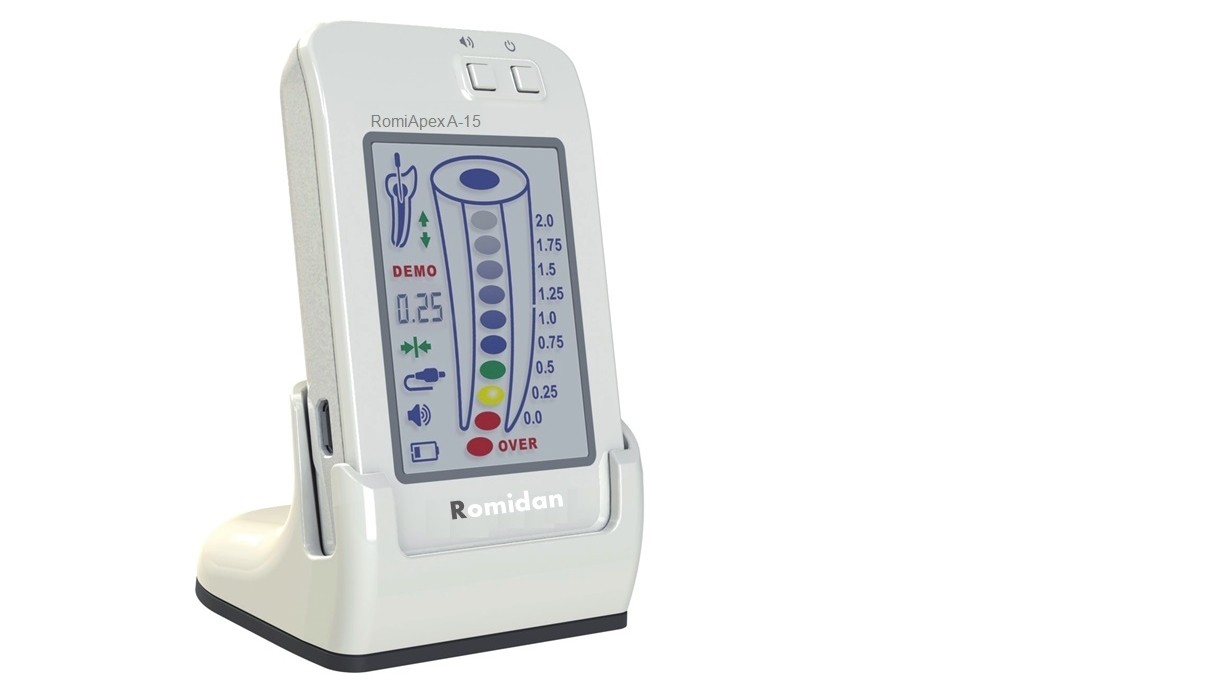
Comparison of Romidan RomiApex A-15 & J Morita Root ZX
SUMMARY
The purpose of this study was to determine the capacity of the studied equipments to locate the foramen exit position correctly, fundamental data for working length determination. Twenty extracted superior central incisors, totaling twenty canals, were used in this experiment. Measurements were executed at the point “0.5” of the new Romiapex A-15 apex locator unit (Romidan, Israel) and at the second green mark indication of the Root ZX II (J. Morita, USA) apex locator unit. Once obtained the electronic reading, the file used as electrode was fixed in position. The gauging of the results was accomplished by wearing one of the external radicular walls of the root apical third, and direct visualization with aid of a surgical microscope. The results indicated that, on average, Romiapex A-15 indicated measures 0,24mm (±0,30) short of the exit of the apical foramen, and Root ZX II 0,21mm(±0,25), not presenting significant differences between the two devices. The analysis of the results indicated that all measurements were inside of an acceptable clinical limit, demonstrating that the tested devices are precise and reliable in the determination of the foramen exit position.
INTRODUCTION
The establishment of the correct apical limit of instrumentation is accepted as one of the most important operative procedures in Endodontics. Significant evidences show that the instrumentation until the limit of the radiographic apex or above and beyond this, it can commit in a irreversible way the success of the clinical endodontic therapy. Although the main radicular canal is limited for the apical foramen, also known as larger foramen, the point of smaller diameter of this canal is found usually in the apical constriction, equally call of smaller foramen, being located, on average, approximately 1mm short of the apical foramen, being able to, still, to vary its position from zero to 2mm short of the foramen. This point contains the pulpal tissue, communicating it to the apical periodontal ligament. The operative procedures in Endodontics should be contained in such limit that doesn’t cause damages to the periapical tissue, favoring the cure and repairing of this area after the treatment. It is accepted that the apical constriction should be the ideal limit of instrumentation and filling. Some techniques of determination of the endodontic working length were described and checked scientifically, among them the digital tactile sensibility, methods based in radiographic analysis, and electronic methods. The third generation of apex locators (APIT, ENDEX, APEX FINDER, JUSTY II, ROOT ZX and ROOT ZX II, BINGO 1020, NOVAPEX, among others), were checked in past studies and in vitro comparison of two electronic apex locators indicated reliable and precise measurements of the position of apical foramen. The presented positive results were shown superiors to those of the INGLE radiographic technique. The present study intends to identify if the new Romiapex A-15 and Root ZX II present necessary and reliable measurements for the position of the foramen, indispensable point in the calculation of the working length.
CONCLUSION: Considering the results of this study, it can be concluded that new Romiapex A-15 and Root ZX II presented precise and reliable measurements in the executed experimental conditions, being shown efficient in the determination of the foramen exit position at clinical limits.
http://www.romidan.com/Media/Doc/Scientific_Articles/Romiapex_A-15_vs_Root_ZX.pdf
Brochado, V. H. D.; Ramos, C.A. S.; Prescinotti, R.; March 2010